Approval Hub: End-to-End Product Journey
From problem discovery to enterprise-wide impact — a case study in product leadership
0→1
Product Build
6+
Source Systems
10K+
Users Impacted
$18M
Target Savings
Executive Pain Point
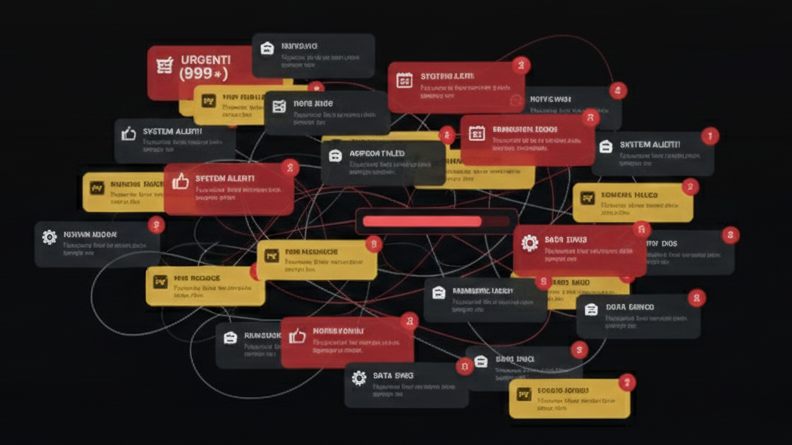
"My inbox is like spam." — Executives couldn't keep track of approvals spread across multiple systems. They were missing important approvals that needed immediate followup.
0 hours wasted.
$0M lost annually. Fragmented approvals killing productivity.
6+
Systems
Spam
Inbox Feel
Missed
Approvals
In-App
Approvals
2.1M+
Users
Live
in ME@
What came next?
User research with operational approvers revealed deeper problems...
72K
Emails/year per user for single contract approvals
Excel
Manual tracking in spreadsheets to avoid duplication
Unused
Phone apps existed but nobody used them
Principal Moment
Quantified the hidden cost through user research: operational approvers spend 2hrs/day on approvals. At $30/hr across 1,000 approvers and 300 working days—that's $18M annual productivity cost. This framing secured executive sponsorship.
Quantifying the Problem
User research revealed the true scale of approval inefficiency.
Operational approvers spend an average of 2 hours per day tracking and processing approvals across multiple fragmented systems.
At an average of $30/hr across 1,000 approvers, fragmented approvals drain millions in productivity.
Approvals pending in millions of dollars
For executive leaders, the same problem compounds at a higher level. Pending approvals represent millions of dollars in procurement decisions sitting in queues—leading to delayed vendor contracts, missed opportunities, and business loss. Time spent tracking approvals is a serious issue at every level of the organization.
$1.8M
Even a 10% efficiency improvement saves millions annually.
$4.5M
Quarter improvement in approval efficiency compounds across the org.
$10.8M
Our target: 5-day → 2-day approval times = 60% time reduction.
Principal Moment
This quantification came directly from user research—interviewing 15-20 stakeholders across different approval domains. Understanding the 2-hour daily burden turned a UX problem into an $18M business case that leadership couldn't ignore.
Leadership Interview Insights
James Bird & Stuart Black on executive approval needs
"Email is a great tool for drawing users into our systems but could be less noisy. For users receiving multiple requests per day, a digest email communicating open items and the priority of open requests would help them understand what's needed."
"Requests should be prioritized based on financial risk and age. When possible, call out risky or sensitive items like contracts so they receive attention quickly."
Priority by Risk & Age
Financial risk assessment combined with aging—relating to a 'burning platform'
Responsive End-to-End
Allow reviews and approvals on executive's phone or iPad—no more waiting for desk time
Single Hub View
Live view of requests across all systems—what's open, priority, and aging in a single list
SLA Tracking
Show aging based on submission and last update—SLAs range from 72hrs to 10 days for legal review
Target User Segments — Initially identified for GNFR, expandable across Walmart
Channel Solution Evaluation
Before building, I questioned: Why aren't emails working?
While engineering was setting up systems, I did the analytical groundwork—evaluating every possible channel to understand constraints and opportunities. Me@Campus and Me@Walmart don't reach all customers and are limited to US markets. This analysis drove our hybrid strategy.
Me@Inbox
Pros
- +Existing channel
- +Easy distribution
Cons
- -Limited to US, CAN
- -Fixed Design and UX scope
- -High dependency on their roadmap
Me@Mini-App
Pros
- +Existing channel
- +Easy distribution
Cons
- -Limited to US, CAN
- -Fixed Design and UX scope
- -Difficult timelines
- -New designs needed per app integration
- -High dependency on their bandwidth
Pros
- +Existing channel
- +Easy distribution
- +No additional development
- +Works across all Walmart markets
Cons
- -Easy to miss notifications
- -No consolidation functionality
- -Users must create filters
- -Limited UX scope
Approval Hub
Pros
- +Can deploy across all Walmart markets
- +Full control on UX and Functionality
- +Scalable to future needs
Cons
- -Becomes another application
Strategic Decision: Build Approval Hub as the core platform with full UX control, while leveraging Me@Inbox for distribution in US/CAN markets. This hybrid approach gives us global scalability while meeting users where they already are.
Prioritization Framework
Beyond standard RICE scoring, we evaluated features against multiple strategic parameters:
Stakeholder Agreement
Executive and team alignment on priority
Business Complexity
Technical and process complexity to implement
Application Integration
Number of systems to connect (Coupa, SAP, etc.)
Impact by Users
Number of approvers affected
Impact by Cost
Potential savings from productivity gains
Scalability
Can this solution extend to other products?
Prioritization Matrix (RICE)
Principal Moment
Measurement Framework
14 custom metrics across 5 categories to measure adoption, performance, and business impact
Source Application
3 metrics
Count of approval requests from Source A(Approvals + Rejects) / Total Requests × 100Σ(Time Out - Time In) / Request CountAdoption Metrics
2 metrics
Users Interacting / Total Source Users × 100Active Users / Target Users × 100Retention Metrics
2 metrics
Repeat Users (14d) / Total Unique UsersMulti-interaction Users / All UsersTeam Performance
4 metrics
Count of approve/reject by teamΣ Team Approval Time / Team ActionsOpen requests assigned to teamActions per team memberImpact Metrics
2 metrics
Notifications Read / Notifications Sent(Before - After) / Before × 100Data Foundation for Intelligent Approvals
The metrics framework creates a rich dataset for training ML models to predict approval times, detect bottlenecks, and enable smart routing.
Key Data Parameters for ML
Designed the measurement framework upfront - not as an afterthought. This enables data-driven iteration and creates the foundation for AI/ML capabilities in the product roadmap.
Navigating Dependencies & Stakeholders
When platform team release cycles meet stakeholder expectations.
2months
MVP1 delivery
3months
Setback from ME@ transition
1quarter
MVP2 rebuild
Biggest Challenge
ME@ Platform Transition
ME@ V2 was the future, so we built for it. Then they changed plans and fell back to V1—we had to build twice.
Impact
Lost 3 months to ME@ platform transition and withdrawn version support
How I Managed It
Pivoted quickly. The solution was modular so we only had to re-scope for V1—reducing rework while ensuring core functionality.
Keeping the Lamp On
When the project was shut down, I didn't give up. I kept working with dependency teams since they were the reason for our delay. I kept selling it to finance teams, tax teams—gathering interest and information for when the moment came.
When John Furner couldn't find his approval request and triggered a sequence of emails to VPs, Approval Hub was revived. Someone told him about it, and his team suggested more applications to be onboarded. I was already ready.
The Furner Moment
The Trigger
John Furner couldn't find the request he needed to approve. After he did, he had to switch between systems and had no access to his account.
The Impact
This triggered a sequence of emails to VPs. Approval Hub was revived and prioritized with more applications suggested by his team to be onboarded.
My Readiness
I was already ready because I had secretly kept it running in the backend—working with dependency teams, selling to finance and tax teams.
Cross-Functional Collaboration
Context:
Engineering wanted Concur first—it was already in ME@ and seemed like a quick win.
How I Collaborated:
Showed data on notifications and flows proving that without notification control, we'd spam all users. Pilot was okay, but enterprise rollout would be a mess.
Result:
Won the argument for notification control first. Quick win isn't a win if it damages user trust.
Journey Timeline
MVP1 Built
Built integration of source applications with ME@ and navigation to source in 2 months
ME@ V2 → V1 Pivot
Lost 3 months when ME@ fell back from V2 to V1
Kept the Lamp On
When shut down, kept working with dependency teams and selling to finance/tax teams
Win Through Reasoning
Aligned Engineering on notification control before Concur rollout
The Furner Moment
CEO couldn't find his approval, triggered VP emails, project revived
MVP2 with In-App Approvals
New research, design, and data integrations built in 1 quarter
How I Collaborate
Bridging business, design, and engineering through structured collaboration
With Engineering
Daily Cadence When Required
Sync only when needed, respecting engineering focus time
Deep Technical Collaboration
Work through data sources, fields, APIs, and design interactions together
Clear Documentation
Documenting flows and user stories on Jira with full context
4iTB Success/Blocker Framework
Bridging business and engineering with structured reporting
Recognize Individual Contributions
Credit team members for pushing through challenging times
Hands-On Problem Solving
Sat with engineering on APIs and vendor solutions—I understand tech to make quick decisions while giving engineering freedom
With Design
Early Involvement
Involve design very early in discovery and research phases
Feasibility Loops
Work through feedback loops and UX options, involving engineering for feasibility checks
Bridge Business & Engineering
Connect design and business early, then design and engineering during delivery
Lead Time Buffer
Push design teams to deliver experiences with multiple ideations, giving engineering at least 1 month lead time
Connecting the triad through structured collaboration
Results & User Feedback
Processing 15K requests weekly. Users love it.
Currently Processing
0
requests / week
Real User Feedback
"The approval process is very seamless. I love how clean the system is."
— Director, Controllership — MVP2 Launch
15K
Requests processed weekly
300+
Active users globally
6
Systems integrated
5
Global regions
Target KPIs
Goals we're working towards
60%
Approval time reduction
5-day → 2-day cycle
80%
Email volume reduction
Via notification consolidation
1,000+
Active approvers globally
Full rollout
User Adoption Journey
Tracking the complete user journey from notification to action
18
MVP1 Pilot Users
300
MVP2 Initial Launch
16x growth6
Applications Integrated
Live now5
Regions Expanded
GlobalPrincipal Moment — Scaling Impact
Started with 18 pilot users, scaled to 300+ in MVP2 initial launch, now processing 15K requests/week. Each phase taught us what users actually need.
The Product Evolution
From 2-month MVP to global platform in one year.
Built MVP1 in 2 months. Lost 3 months to ME@ transition. Rebuilt MVP2 in 1 quarter with fresh research.
Phase 2 — LIVE
Currently in production
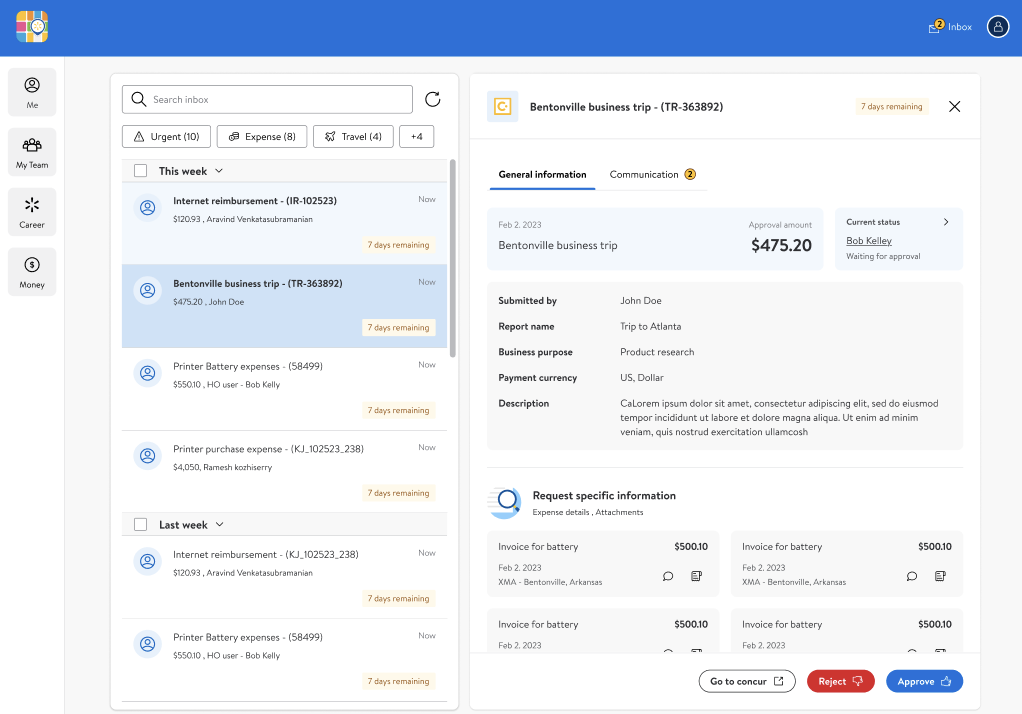
In-App Approvals
Approve/reject directly within ME@Inbox without switching systems
Notification Control
Users can manage which notifications they receive and how often
Multi-Application Support
Coupa, SAP, iP2P, iCatalog, and more integrated
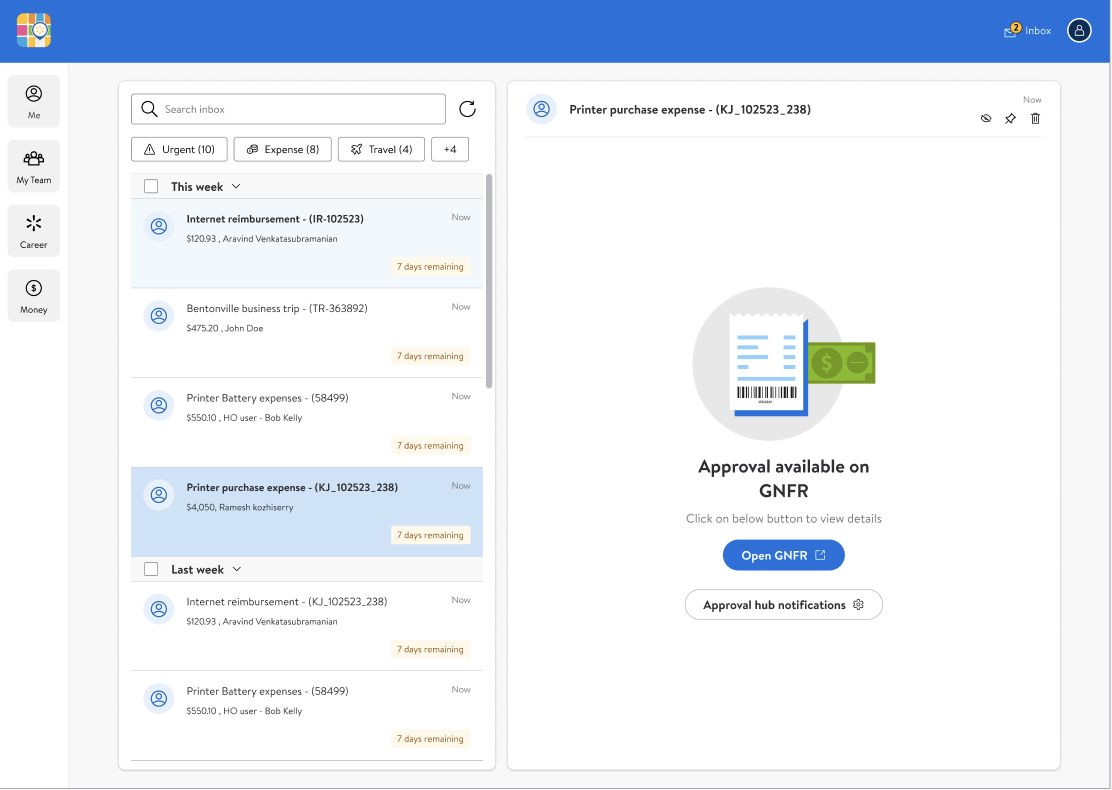
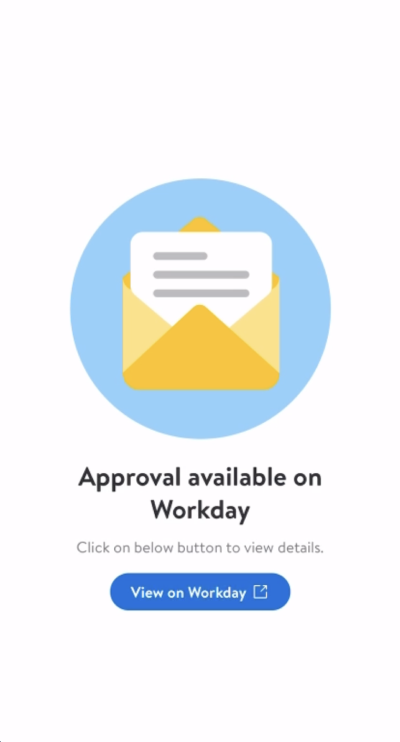
Navigation to Source
One-click deep links to source system for complex approvals
MVP1: Navigate to Source
Built in 2 months
Integrated source applications with ME@Inbox in just 2 months. Users see approval details and navigate to source system to take action. Reduced context switching while proving the concept.
Delivery
2 Months
Pilot Users
18 users
Integration
4 Systems Live
Setback
Lost 3 months due to ME@ platform transition—they fell back from V2 to V1. Had to rebuild, but modular design meant only re-scoping, not starting over.
Platform Influence
Features I championed that were adopted by ME@Inbox for ALL inbox users:
ME@ team now wants to partner with us in their revamp—positioning Approval Hub as a core feature.
Principal Moment — Platform Partnership
Positioned our requirements as win-win for ME@Inbox team—identified opportunity areas and drove collaboration. Now they want to partner with us in their revamp and have Approval Hub as a core feature.
The Path Forward
Three-phase roadmap to increase adoption, stickiness, and organizational impact
Phase 1: Foundation
Q1-Q2 FY27
Onboard 5+ Applications
Expand integration coverage to streamline approvals across more enterprise systems
ALIGNS TO:
Enhanced Data & Actions
More data customizations, comments, attachments for richer approval context
ALIGNS TO:
Phase 2: Platform Scale
Q2-Q3 FY27
Self-Onboarding
Empower business teams to onboard applications and streamline approvals independently
ALIGNS TO:
Custom Approvals
Platform to generate approval flows for any process—stores, people, internal teams
ALIGNS TO:
Phase 3: Intelligence
Q3-Q4 FY27
Smart Prioritization
Rule-based and usage-based recommendations to optimize approval workflows
ALIGNS TO:
Squigly Integration
Conversation-based approvals for natural, chat-driven workflows
ALIGNS TO:
Approval Analytics
Team and application-level analytics for visibility and optimization
FY27 Objective
Drive enterprise-wide approval transformation through increased adoption and stickiness
Increased Adoption
Expand to more teams and use cases
Enhanced Stickiness
Make Approval Hub indispensable
Org-Wide Impact
Drive visibility and value